Direct answer: KENFA MTR 0.8R0.05 L3-D4 is a catalog-listed small-aperture boring tool made from tungsten steel cemented carbide under the antique-copper group. Official MTR series tables support reading R0.05 as a 0.05 mm radius, L3 as 3 mm cutting length and D4 as a 4 mm shank series. Exact minimum bore, holder assembly and cutting data still require RFQ confirmation.
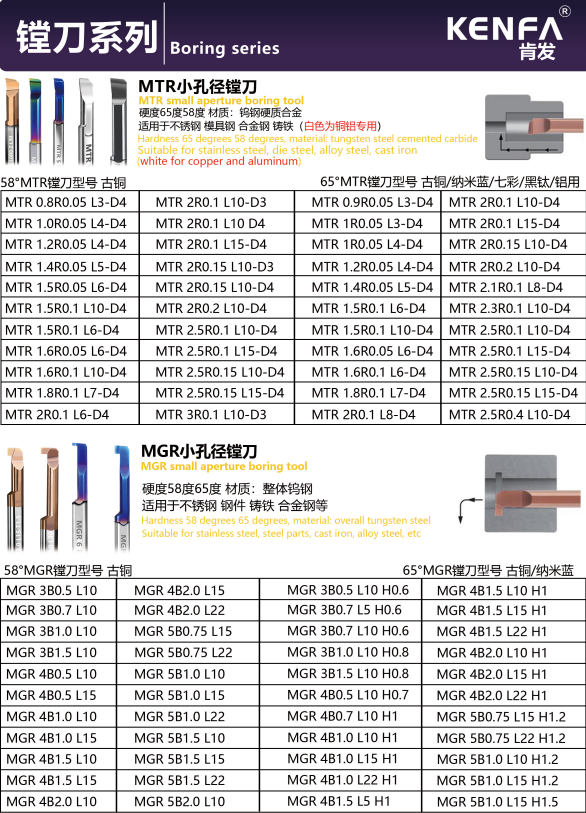
Which MTR facts are confirmed by KENFA?
| Field | KENFA-confirmed value | Evidence boundary |
|---|---|---|
| Model | MTR 0.8R0.05 L3-D4 | Exact catalog row; treated as a model, not an inventory SKU. |
| Family | MTR small-aperture boring tool | KENFA catalog family heading. |
| Material wording | Tungsten steel cemented carbide | Catalog family wording; no carbide grade code or chemistry is supplied. |
| Catalog group | 58-degree / antique copper | Visible group label. No hardness scale is inferred from 58 degrees. |
| Family application context | Stainless steel, die steel, alloy steel and cast iron | Family context, not a universal cutting-performance guarantee. |
What do R0.05, L3 and D4 mean?
The KENFA image prints the model as one designation but does not include a legend. An official MTR small-bore tool table from another manufacturer labels the same code pattern by total length, cutting-edge length, R radius and minimum bore. This provides an external code cross-check, not a substitute for a KENFA drawing.
| Code token | Cross-checked interpretation | Publication boundary |
|---|---|---|
| 0.8 | Leading nominal size token; an exact MTR 0.8R0.05 L3 listing exists in another manufacturer catalog | The available external table does not label the exact KENFA 0.8-D4 row or its minimum bore, so no bore diameter is asserted. |
| R0.05 | R radius 0.05 mm | Supported by the labeled external MTR specification table. |
| L3 | Cutting-edge length 3 mm | Supported by the labeled external MTR specification table. |
| D4 | 4 mm shank series | Inferred from the table’s separate D3 and D4 model blocks; confirm the exact KENFA shank drawing. |
| Overall length | 50 mm on the comparable published D4 MTR rows | Analog-series reference only; not exposed as a KENFA Product Schema dimension. |
What holder interface is required?
The D4 code is consistent with a 4 mm cylindrical-shank series. The machine-side setup therefore needs a holder, collet or reduction sleeve capable of clamping a 4 mm round shank. The KENFA catalog page does not name a holder SKU, sleeve, projection limit, hand or orientation, so those details must be checked against the buyer’s machine and boring setup.
Which coating and grade are verified?
KENFA identifies the selected group with the catalog coating label antique copper and describes the family material as tungsten steel cemented carbide. The public source does not state coating chemistry, thickness, process, carbide grade code, grain size or binder composition. Those fields remain quotation-confirmation items rather than inferred specifications.
What cutting parameters should be used?
No exact KENFA or exact-model public source was found for cutting speed, feed, depth of cut or coolant. Publishing a competitor’s values as KENFA parameters would be unsafe. KENFA should set starting values after receiving the workpiece material and hardness, bore size and depth, tool overhang, machine speed range, holder rigidity, coolant and surface-finish requirement.
How should buyers confirm the exact MTR configuration?
- Send the complete model designation and a clear tool or drawing image.
- State the target bore, depth, tolerance, surface finish, workpiece material and hardness.
- Provide the machine, available 4 mm clamping arrangement, overhang and coolant.
- Include quantity, destination country and the current machining problem.
Buyer questions
Is R0.05 a verified 0.05 mm radius?
It is supported by the labeled external MTR specification table. Because KENFA’s page lacks a legend, the final order drawing should still confirm the geometry.
Does L3 mean a 3 mm cutting length?
Yes in the referenced MTR coding table, where the L value matches the cutting-edge-length column. It is published here as a code cross-check rather than a KENFA drawing dimension.
Does D4 name a proprietary holder interface?
No proprietary interface is identified. The available MTR tables separate D3 and D4 shank series, supporting a 4 mm cylindrical-shank interpretation for D4.
What is the minimum bore?
The exact KENFA 0.8-D4 row is not present in the labeled external table, so this page does not infer a minimum bore. KENFA should confirm it from a drawing or quotation.
Can one cutting-data table be used for every material?
No. Small-bore tool parameters are highly sensitive to material, bore depth, overhang, holder rigidity, coolant and machine speed. Exact starting values require application review.
Sources and verification boundary
- KENFA source: 2025 KENFA cutting tools catalog, Boring Series, PDF page 20, printed page 29, production media attachment 13.
- External labeled MTR code table: Perfect CNC MTR small-aperture precision boring tool specifications.
- External exact 0.8 designation cross-check: Jat Carbide MTR model list.
Review the MTR series page, compare the Boring Tools family, or send a technical RFQ.