An ISO turning insert designation is a structured purchasing code, not a complete cutting recommendation. Read the base positions for shape, clearance, tolerance, insert type, size, thickness and corner radius, then treat chipbreaker and grade suffixes as manufacturer-specific data. Always confirm the full code against the holder seat, manufacturer catalog and selected application before ordering or requesting an equivalent.
What does the common base designation communicate?
For common metric turning insert codes, read the base designation in groups. The full symbol tables and dimensional meaning remain governed by the applicable standard and manufacturer catalog.
| Code position or group | What it identifies | Buyer check |
|---|---|---|
| First letter | Insert shape | Confirm the shape and included angle required by the holder and operation. |
| Second letter | Relief or clearance characteristic | Do not treat a similar outline as the same clearance style. |
| Third letter | Tolerance class | Use the full code; a missing or changed letter can alter the controlled dimensions. |
| Fourth letter | Insert type, including fixing or chip-control features defined by the system | Confirm the seat, hole and clamping requirement against the holder. |
| Following size groups | Insert size, thickness and corner-radius codes | Convert codes to dimensions only with the standard or manufacturer table. |
| Suffixes | Manufacturer geometry, chipbreaker, edge preparation or grade information | Treat each suffix as manufacturer-specific unless its source defines it. |
How should a code such as CCMT 09 T3 04 be read?
The example separates into four letters followed by size, thickness and corner-radius groups. It demonstrates the reading order only. It does not authorize a KENFA equivalent, holder fit, dimensional conversion, chipbreaker, grade or coating without the exact catalog and application record.
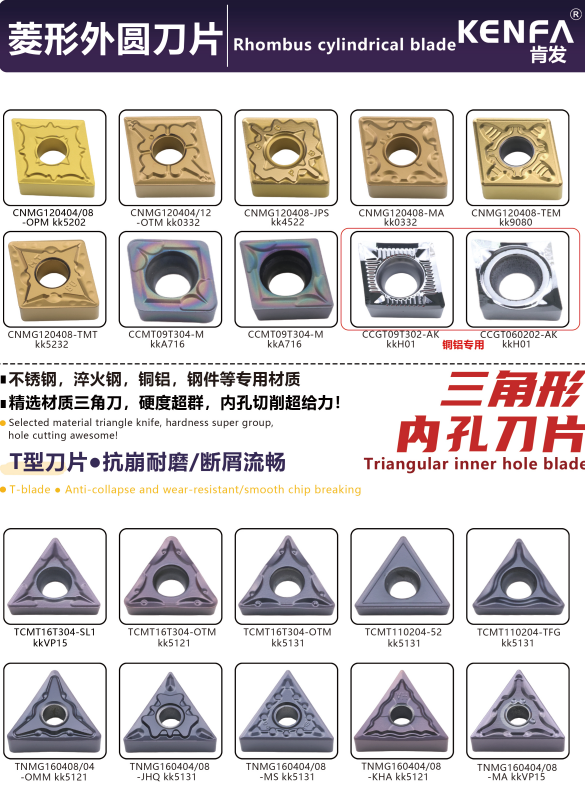
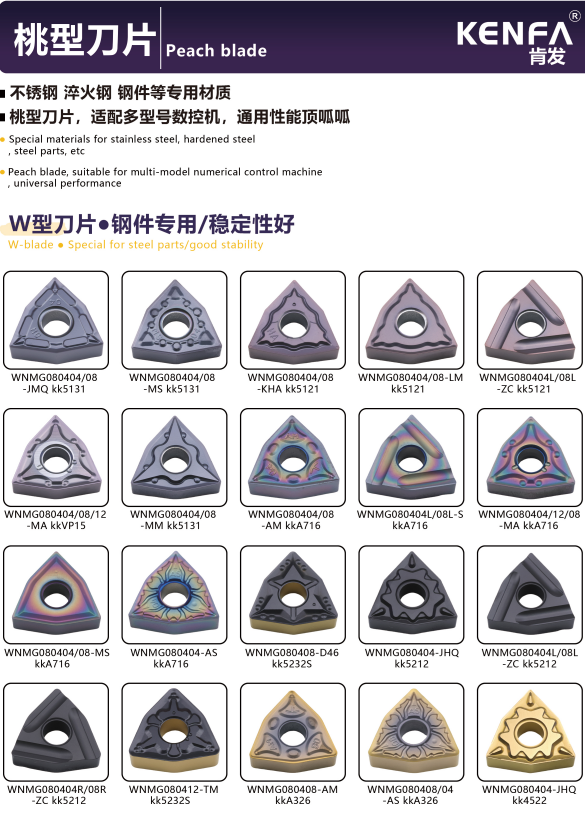
Which images help buyers identify insert families?
Family images can help identify visible shapes or locate a current package label, but they do not replace the complete designation or holder code.
What should buyers copy from the current insert?
- The complete printed designation, including spaces, hyphens and suffixes.
- The holder code and a clear photo of the insert seat and clamp.
- The manufacturer, grade and chipbreaker markings when present.
- The workpiece material, operation, current problem and required quantity.
- Package and insert photos if any character is unclear.
Which KENFA pages should buyers use next?
Review Cutting Inserts, Cylindrical Tool Holders and How to Prepare a Cutting Tool Compatibility RFQ. Then send the full code through the cutting-inserts RFQ path.
Buyer Questions
Does the base ISO code include every manufacturer suffix?
No. Geometry, chipbreaker, edge-preparation and grade suffixes may be manufacturer-specific and must be read from that source.
Can shape and size alone confirm holder compatibility?
No. Clearance, tolerance, fixing style, seat, clamp and complete holder code also matter.
Can KENFA match an insert from a partial code?
A partial code can start the review, but send package photos, holder code, dimensions and application details to resolve missing characters.
Does an ISO designation provide cutting conditions?
No. Cutting conditions require the selected model, material, operation, machine and engineering-reviewed data.
Source Notes
ISO 1832:2017 establishes the designation code for usual types of indexable inserts and was confirmed current by ISO in 2022. The grouping example was cross-checked against an official Sandvik Coromant CCMT product record, which separately identifies shape, clearance, size, thickness, corner radius, chipbreaker and grade fields. KENFA catalog images CI-04 and CI-07 are visual family references only. Last reviewed July 12, 2026.